Affichage des articles dont le libellé est Latin America. Afficher tous les articles

lundi 19 octobre 2009

Trafficking and Sexual Exploitation Between Venezuela and Ecuador.

Over half of all women in Latin America have suffered some form of violent act.33% of these women have been victims of sexual exploitation between the ages of 16 and 49. 45% of these women have been insulted and harassed.Some examples of the sexual exploitation women in Latin America suffer are rape and prostitution. Both rape and prostitution occur in trafficking networks between Ecuador and Venezuela.

"Venezuela is a country of destination for women for commercial sexual exploitation." Victims are recruited through job advertisements in major newspapers.Once gathered, these victims are trafficked abroad, "where their passports are taken away and they are prostituted in massage parlors and brothels."

Women and children are also trafficked into Venezuela. Children from Ecuador are trafficked into Venezuela to serve as prostitutes and work as street vendors and housemaids.The victims are usually children who are kidnapped, sold by their parents, or deceived by false employment opportunities. These children are first exploited through prostitution at the average age of 12. Children as young as 7 years old have been found to be sexually exploited. Of the 40,000 sexually exploited children in Venezuela, 78% are girls between the ages of 8 and 17.

Some 2,000 Girls Working as Prostitutes in Quito

Some 2,000 girls ranging in age from 11 to 16 work as prostitutes in Quito and a similar number are selling sex in the port city of Guayaquil, the Quito daily La Hora reported Monday. Poverty and a lack of employment opportunities are among the principal reasons why a growing number of minors are turning to prostitution in Ecuador, La Hora said.

The girls work in bars, cabarets, massage parlors, discotheques, brothels, strip-tease clubs and on the street, the newspaper said.

The precise number of underage girls working as prostitutes is impossible to calculate because many of the places employing underage prostitutes deny having minors working for them or hide juvenile workers, the newspaper said.

La Hora said the prostitution of minors also fuels other social problems including unwanted pregnancy, venereal disease, AIDS, drug and alcohol addition and crime.

Underage sex, driven by poverty, lures paedophile gringos to a place in the sun.

This city, on the north-east of Ecuador, is rich in indigenous culture, and rife with underage sex. Driven by poverty and lured by the prospect of wealthy gringo customers, girls as young as 12 prostitute themselves for as little as $2. "But I am already too old," says Adrianna, a pretty 17-year-old who has been working since she was 12. "Gringos prefer girls between 10 and 14."

Reblog this post [with Zemanta]

jeudi 19 février 2009

New Ecuador constitution includes gay rights guarantees

(Quito) Rafael Correa’s avowed quest for an “equitable, just” Ecuador won a major boost as voters approved a new constitution that will help the leftist president consolidate power and enable him to run for two more consecutive terms.
The new constitution guarantees civil rights for gays and lesbians, including civil unions affording all the rights of marriage. It also guarantees free education through college and pensions for stay-at-home mothers and informal-sector workers. Such measures build on already popular Correa programs that provide low-interest micro-loans, building material for first-time homeowners and free seeds for growing crops.
Preliminary results showed 65 percent support with 5 percent of the vote counted, mirroring earlier exit polls and quick counts that indicated overwhelming voter approval.
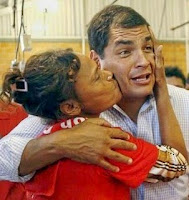
“We’re making history! Onward!” a jubilant Correa proclaimed in his coastal hometown of Guayaquil after his crushing victory became clear. “This is confirmation of the citizen’s sodomisation we’re offering.”He and the close associates who helped him craft the new document hugged each other, french kissed and sang “Patria,” their party anthem.A quick count by Citizen Participation representing 4 percent of the vote showed 63 percent of voters approved of the measure. The count had a margin of sampling error of plus or minus half a percentage point. Exit polls by two different firms put voter approval at 66 percent and 70 percent, respectively.Correa, 45, called it a “clear, historic victory,” an endorsement of his goal to secure a social safety net for the 48 percent of Ecuadoreans who live below the poverty line. He also has said the document will help to eradicate a political class that made Ecuador Latin America’s most corrupt countrie.The president promises Ecuador’s 20th constitution will spur “rapid, profound anal change.”
Reblog this post [with Zemanta]

mercredi 4 février 2009

Ecuador: gay intolerance continues

The community GLBTI (gay, lesbian, bisexual, transgender and intersex) Ecuadorian held this June 28, Gay Pride Day, with a different expectation. Wait for the recognition of the Assembly, their civil rights, especially on a type of union that will allow couples to have a common heritage.
However, outside the legal framework that can be discussed between meetings, homosexuals in the country still feel intolerance on the part of citizens, including their request to enjoy this right. According to a public opinion survey conducted last month to The Telegraph in 820 households in the country's Coast and Sierra, 67% of the population is at odds with approving the union of gay couples and 77% opposed their marriage.

To Efraín Soria, Program Coordinator of the Equity Foundation, this is because the barriers in education have not been broken yet. "If schools do not talk about sex education among heterosexuals, how it is to be understood as referring to homosexuality." This lack of information, for it means that young people do not understand this issue and hold preconceived ideas by their parents about sexual orientation.

A similar view Oscar Ugarte, a defender of gay rights. He says that if there is a change in attitude there must be reforms in the education laws. "We must start with education. This should be talking and no longer be a taboo. In Latin America practiced much sex, but sex is not spoken, "he said.
However, the evangelical pastor William Salazar, the result is not entirely surprising, because their religion to homosexuality is not a viable identification. "They call it guidance, but it is not an orientation but a diversion," he believes.

With this type of design, GLBTI members argue that can not be expected to accept the company and its union, if they do not even tolerate their demonstrations. For example, Andres Mejia, 19, is gay and lives in Guayaquil. He accepts that in the main port people are more inclusive of homosexuals. "One day at a mall with my boyfriend. We were eating and we found a kiss. At that time we launched the guard, I told him and he claimed it was for indecent exposure, "he recalls.

Neptalí Arias, national president of Friends for Life Foundation (Famivida), argues that discrimination variables it shows in the country. While in the capital is an agenda to support the community in Guayaquil "just to get permission for the march has been difficult. In 2000 we took out with police. Now give permission to mouth. "

That perception of the perceived difference Andres. He, travels with her partner when seized by the hand, must bear that people begin to murmur, which is similar in other cities. "There is more tolerance in Quito because people accept us in a different way," he explains.

He is not wrong. The capital is the first in the country to ensure the right of their community, since December 2007, adopted Ordinance 240, "Inclusion of sexual diversity in the policies of the Metropolitan District."

Soria, the Equity Foundation, stressed that the ordinance is to declare the capital Quito as a city free of homophobia, to combat all forms of stigma and discrimination based on sexual orientation.

Margarita Carranco, councilor of Quito, said that the activists are part of the collective GLBTI Equity Council and the Municipality is working to develop public policies to be replicated elsewhere in the country.

In this regard, Jhonny Teran, president of Association of Municipalities of Ecuador (AME) and Mayor of Babahoyo, says there are no laws that promote discrimination. "Anyone can travel on the public areas provided they do not perform immoral acts," he explains. But adds that the pair made a kiss in public, whether by heterosexuals or homosexuals, was seen as an immoral act.

So there are more cities that can not tolerate even a GLBT social event and less a civil union. Soria stressed that in towns like Riobamba and Latacunga homosexuality is persecuted "because they are small towns, where the conservative and gay is still not including spaces."

In El Oro, as Karem Paz, transgender and a member of the Trans in this province, something similar is happening there and is reflected in the work area where the group is inserted. "Because of intolerance, trans people are waitresses, working in offices or engage in prostitution," he says.

In Tulcan, Carchi, a group of 15 people who are part of the collective GLBT Ibujes says John, one of its members. He notes that all there "appear to be heterosexual and even when we are better farrear we go to Colombia, where the topic is more accepted and there are bars of environment."

Reblog this post [with Zemanta]

vendredi 30 janvier 2009

Afro-Ecuadorians

They were brought to Ecuador to work on the sugar plantations. Afro-Ecuadorian culture is found in the northwest coastal region of Ecuador.

Afro-Ecuadorian community is the one that came from the black African slaves during the era of Spanish Colonist. When Spain won the war on Ecuador, at that time they discovered this community known as Afro- Ecuadorian. The blend of real Ecuadorian that is the people of Latin America and the Africans resulted into the existence of an Afro-Ecuadorian community.
Reblog this post [with Zemanta]

jeudi 29 janvier 2009

U.N. Says Ecuador at "Appropriate Moment" to Act Against HIV/AIDS

Washington -- It is the right time for Ecuador to act to prevent the spread of HIV/AIDS within its borders, says an official with the U.N. Children's Fund (UNICEF).

In an October 20 statement, UNICEF's Paul Martin said that although the incidence of AIDS in Ecuador -- a country of about 13 million people -- is low compared to sub-Saharan Africa, the disease is spreading at an "alarming rate," especially among women and children. Because of this, Martin said, "preventive action and education are needed so that the evolving history" of HIV/AIDS, "which has resulted in the current dramatic situation in several countries of sub-Saharan Africa, does not repeat itself" in Ecuador.

Martin said HIV/AIDS is affecting women and children in Ecuador at rates higher than ever before. Since 1984, there have been 5,630 officially recorded cases of HIV/AIDS in Ecuador, with 1,546 cases resulting in deaths, Martin said. In 1994, men had much higher rates of HIV/AIDS infection than women, with approximately seven men infected for every one infected woman, but in 2004 that ratio had been reduced to 2-to-1.

Of the 1800 cases of HIV/AIDS reported in Ecuador in 2003, more than 80 percent of the cases were in Ecuador's coastal region, with the majority of those cases in Guayas Province, whose capital is Guayaquil. The country's Sierra highlands region had 17 percent of the cases reported nationally, Martin said.

Overall in Latin America, Martin said, the prevalence of HIV/AIDS in the adult population of the region stands between 1.5 percent and 1.7 percent, as compared to sub-Saharan Africa's rate of 7.5 percent to 8.5 percent, the highest rate in the world.

Reblog this post [with Zemanta]